


Treatments and consultations
What each treatment involves, how a consultation works and what to bring, from your own treatment pages.
A chatbot on your clinic's website that explains your treatments and takes consultation requests. Every clinical question goes to your practitioners.
Discuss your chatbot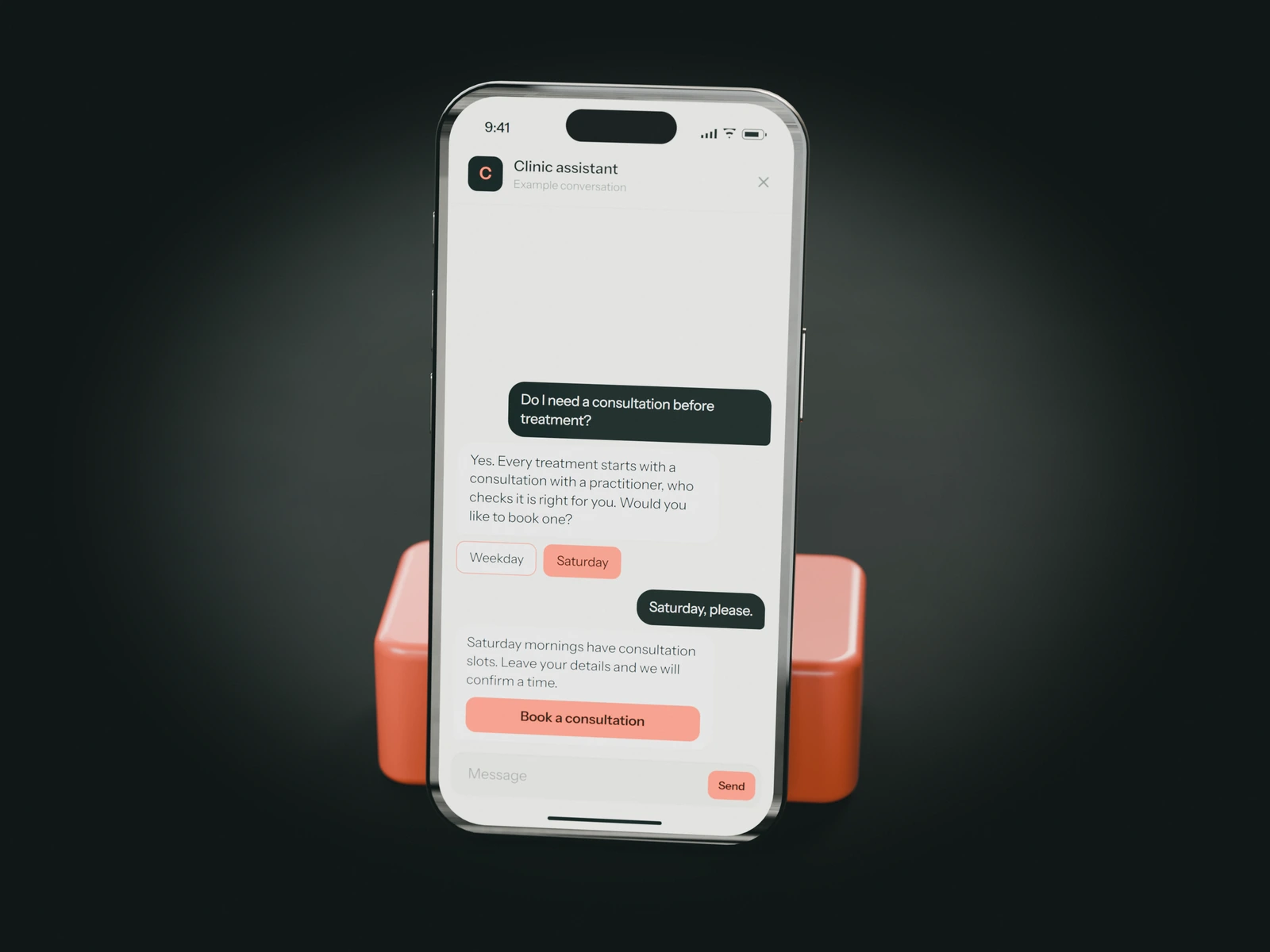
Which treatments you offer, whether a consultation comes first, how long results last, what aftercare involves, what it costs and whether there is anything on Saturday. Most of it is on your treatment pages already. The chatbot answers from the version you approve, and nothing else.
Most have a written answer on your website, but the last group never gets one from the chatbot: it goes to a practitioner.
What it may say is written down before we build.
What each treatment involves, how a consultation works and what to bring, from your own treatment pages.
It collects the patient's details, the treatment they are interested in and preferred times, and sends the request to your team or booking system.
Before and after instructions you write, sent at the right moment, so patients arrive prepared and know what to expect.
Prices exactly as your price list states them. When a price depends on the consultation, it says so.
The consultation deposit, whether it comes off the treatment price and what happens to it after a late cancellation or a no-show, explained in your words before anyone books. Taking the payment stays with your booking tool.
Who carries out each treatment, their profession and qualifications, and the days they work, from your team page. Patients ask whether a doctor, nurse or dentist does the injections, and the chatbot answers with your wording.
Gift vouchers, what they can be spent on, and courses such as a set of laser or skin sessions. If your policy says a voucher for injectables still needs a consultation first, the chatbot says so up front.
Thursday, 10.40pm. Someone wants lip filler before their wedding, has looked at the price list and asks one thing the chatbot must not answer.
What your team gets. In the morning the coordinator has an evening consultation request with the wedding date, a mobile number and a question flagged for the practitioner, plus the whole conversation. Nobody has told the patient yes or no about treatment.
It does not say whether a treatment is right for someone, comment on symptoms, photos or medical history, or promise results. Those questions go to a practitioner with the conversation attached. Problems after a treatment get your clinic number straight away.
Requests reach your coordinator, and aftercare messages go out on time.
Consultation requests reach your booking system or inbox with the treatment and preferred times.
A reminder before a consultation, aftercare instructions after a treatment and, with the patient's permission, a note when a top-up is usually due.
Jobs that run between the first enquiry and the next appointment, set up where your clinic software does not do them already and its API allows.
Your medical questionnaire goes out as soon as a consultation is booked, with a reminder if it is not back the day before. The practitioner reads it before the patient arrives, and the answers never pass through the chatbot.
If your clinic keeps a cooling-off period between consultation and treatment, the treatment booking link goes out when it ends, with the notes the practitioner wants the patient to read again first.
A short message at the interval your practitioners choose, asking how the patient is. Every reply goes to the practitioner, so a worry about swelling or a lump is read by someone who can judge it.
If your practitioners offer a review after anti-wrinkle treatment, the booking link goes out when they choose. Patients who do not book get one reminder, and your coordinator sees who is still missing.
For laser and skin courses, the next session is offered at the interval the practitioner set. A patient with sessions left and nothing booked gets a nudge, and your coordinator sees who has stopped.
Some of it is on your treatment pages already; the urgent list and the aftercare wording need your practitioners.
Each treatment as you name it on your website, with its price or "from" price and what depends on the consultation. A price list PDF or a spreadsheet is fine.
Who needs a consultation, the deposit and how it is taken, any cooling-off period, your cancellation and no-show rules, and your minimum age. Plain sentences, as you would brief a new coordinator.
Your written aftercare for each treatment, the number for problems in opening hours and the out-of-hours contact. Your practitioners approve the list of words that send a patient straight to it.
Who does which treatment, their profession and qualifications, and the days they work, so the chatbot never offers laser on a day nobody does it.
The name of your clinic or booking software, such as Pabau, Consentz or Zenoti, and who manages it. We check its API before promising that a consultation request arrives with the treatment and practitioner already filled in.
A few weeks of website, Instagram and WhatsApp messages with names removed. They show how your patients really ask, slang and brand names included.
These pages help patients decide, and the chatbot answers from them, so they are worth getting right.
One page per treatment: what it is, who does it, what happens at the consultation, the downtime your practitioners describe and the "from" price. No promised results, and no brand names your rules keep off the page.
Results from your own practitioners, each shared with the patient's written consent and labelled with the treatment. Take the before and after photos the same way and leave them unfiltered, so patients can trust them.
Each practitioner's profession, qualifications and, where they have one, their professional registration, which patients can check with the regulator. Patients want to know who will be holding the needle.
One page per treatment with your aftercare instructions and the number to call if something feels wrong, in hours and out of hours. Patients look for it at night, a day or two after treatment.
Booking a consultation on a phone, with the deposit taken by your booking tool. Every extra step between a treatment page and a confirmed slot is a place where people give up, so keep it short.
If you run Instagram or Facebook ads for a treatment, each ad should land on a page about that treatment. The home page makes people search again. See landing pages for ads.
People tell a clinic's chat things they would not post anywhere: what they dislike about their face, the medicines they take, a pregnancy, a treatment that went wrong elsewhere. The chatbot asks only for a name, contact details, the treatment they are interested in and preferred times. Medical questions move to your questionnaire, which the practitioner reads.
A message about a medicine or a past reaction is health data, even when it arrives through a booking chat. HIPAA applies in the US where it covers your clinic, and the GDPR treats health data as a special category in Europe. We agree storage and access before launch, and we suggest leaving photo uploads off, so no face photo is kept with a conversation.
Discretion matters too. Reminders and aftercare messages can say "your appointment at the clinic" instead of naming the treatment, since a phone screen is not private. Marketing messages go only to patients who have said yes to them, recorded separately from the booking.
No. It answers practical questions from information you approve and sends anything about suitability, symptoms or results to a practitioner.
Yes, from your own price list. When a price depends on the consultation, it says so instead of guessing.
Health information has extra rules in most countries, so the chatbot asks only for what a booking request needs. We agree storage and access before the build.
Yes, the instructions you write, after the right treatment.
Yes, offers you write down with their terms and end date. It does not invent offers, haggle or add pressure to book. When an offer ends, you remove it from the information the chatbot answers from, and it stops mentioning it.
It does not answer for that person. It explains what the consultation covers and who carries out the treatment, then offers a consultation, where a practitioner goes through their medical history. The question goes into the request so it is not lost.
Yes, for practical questions about GP appointments, health checks, blood tests or travel vaccinations: what you offer, prices, hours and how to book. The rules stay the same. Symptoms and test results go to a clinician, and urgent symptoms get your emergency instructions.
The chatbot says plainly that you do not offer it. It does not describe the treatment or suggest an alternative, because what suits someone is a consultation question. If you want, it can offer a consultation instead.
It answers from your approved pages, which should not promise results either. Before launch we test it with the questions patients use to fish for a promise, such as "will I look younger?", and you try it yourselves. After launch you can read every conversation and fix the page behind a weak answer.
Your treatments and the questions patients ask are enough to start. The consultation is free, over Google Meet, a voice call or text.