


Details for a quote
Property type, bedrooms and bathrooms, how often, extras such as ovens or inside windows, and the postcode. If you publish fixed prices for standard cleans, it quotes from that list.
A chatbot on your website that gathers what you need to quote a clean and passes skip and reschedule requests to whoever runs the schedule.
Discuss your chatbot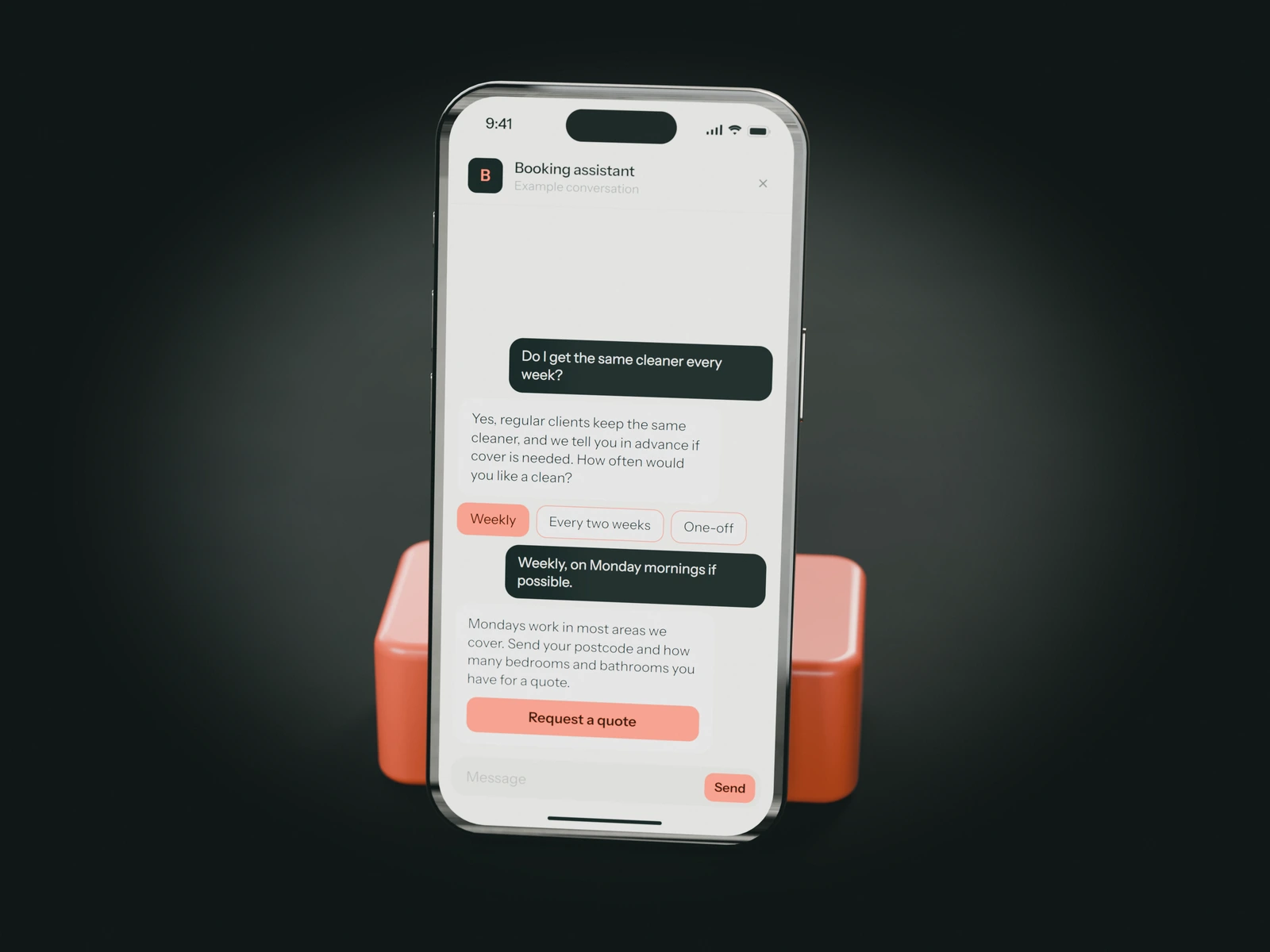
Do I get the same cleaner each time, do you bring your own products, are your cleaners insured and background checked, do I need to be home, will you do the oven and can you clean our office after hours. Your office answers these while rearranging the schedule. The chatbot answers from your service list and policies.
Most have one answer in your price list or your terms, and one-off jobs always need a person to price them.
What it may say is written down before we build.
Property type, bedrooms and bathrooms, how often, extras such as ovens or inside windows, and the postcode. If you publish fixed prices for standard cleans, it quotes from that list.
Regular, deep, move-in and move-out cleans each follow their own checklist, and it explains what is included and what costs extra. Jobs you do not take on, such as moving heavy furniture, are named up front.
Customers who want to skip a clean or pause over the holidays get your notice policy, and the request goes to your scheduler or booking software where its API allows.
Businesses are asked about floor area and when the building is empty, and the enquiry goes to whoever arranges site visits.
Agents and landlords who book cleans between tenancies are asked for the property, the move-out and move-in dates, who holds the keys and who pays. The enquiry goes to whoever looks after agency accounts, with the agent's checklist attached if there is one.
Check-out and check-in times, linen and towel changes, restocking and photos for the host after each clean. Where your scheduling software can read the host's booking calendar, new stays become jobs without anyone typing them.
Dust after building work, paint splashes, carpets and windows: it collects the rooms, the kind of mess and photos where your tools accept them, then sends the request to whoever prices one-off jobs. Nobody gets a price before a person has looked.
A tenant writes on a Tuesday night, ten days before she hands back the keys to a two-bedroom flat. She wants a price there and then.
What your team gets. A quote request for an empty two-bed on the 28th, with carpets in both bedrooms, the agent's checklist and photos attached, and the bathroom mould flagged for a manager. Nobody has been promised a price.
It never asks for alarm codes or key safe numbers. Your team collects those through its own process. It does not promise a deposit back after a move-out clean, and complaints or breakages go straight to a manager.
Each booking reaches your scheduler with the rooms and extras noted.
New clients and moved or skipped cleans go into your scheduling software where its API allows, or into a sheet your office checks each morning.
A reminder before the first clean, and a short check-in after it, so a problem reaches you before it reaches a review site.
These run from your scheduling software, where its API allows, and cut the calls your office makes every week.
When a cleaner calls in sick, the customers on their round that day get a message from the office with the options you set, such as a cover cleaner or another day. Nobody rings round at 7am.
Before Christmas and the school holidays, regular customers are asked which cleans to skip. Their answers update the schedule where your software allows, so the office sees the gaps well before the day.
End of tenancy and deep clean quotes get one follow-up at the time you choose, with the date the customer asked for. If they say yes, the job reaches the scheduler with the details from the chat already filled in.
Once a first clean is booked, the customer gets a link to a secure form for keys, alarm and parking, or a call from the office if you prefer. The details go into the job, not into a chat log.
Commercial clients get your insurance certificate, risk assessment and COSHH or safety data sheets with the quote. When your insurance renews, the new certificate goes to every commercial client without anyone digging it out.
Most of it is already on your price list, in your terms or in the head of whoever answers the phone.
The checklist your cleaners use for each type of clean, as a document or a photo of the sheet. The chatbot answers 'is that included' from it.
Fixed prices if you have them, and the rules behind every other quote: hourly rate, minimum hours, extras, weekend and same-day charges. This decides when the chatbot may show a price and when a person must quote.
The postcodes or ZIP codes you cover, and any areas you only serve on certain days. A list or a spreadsheet is enough.
Access to your scheduling software, such as ZenMaid or Jobber, so we can check what its API allows: new clients, skips and the cleaner on each round. If it cannot connect, requests reach an inbox in the same format.
Skip and cancellation notice, the re-clean policy, breakages, pets and key handling, as your terms state them. The chatbot repeats them word for word.
Who prices one-off jobs, who runs the schedule, who looks after office clients and who deals with complaints, and whether each wants a call, a text or a note in the scheduling app.
Messages from your website, email and Facebook with names and addresses removed, including the awkward ones about deposits and breakages. We test the chatbot on them before launch.
People choosing a cleaner want to know what is included and who will be in their home. These are the pages a cleaning company's website needs.
Property type, bedrooms, bathrooms, how often and the postcode, plus a photo upload for one-off jobs. It collects what the chatbot collects, for people who prefer a form.
Regular, deep, end of tenancy and after builders, each with its full checklist, what costs extra and what you do not do. Customers can compare what is included before they ask for a price.
A page for each town or district you cover, with the postcodes and the days you clean there. People search for a cleaner in their own town, and these are the pages they find.
How you hire, check and train cleaners, your insurance, how keys are stored and what happens if something breaks. These answers decide whether someone lets a stranger into their home.
Out-of-hours cleaning, contract terms, and your insurance certificate and safety documents on request. Office managers look for these before they ask for a site visit.
Where your prices are fixed and your software takes online bookings, customers book a standard clean on the website. Everything else goes to the quote form, so nobody books a deep clean at a regular price.
Cleaning chats hold the details a burglar would want: an address, the days a home is empty and how to get in. The chatbot asks only what a quote needs, such as the postcode and the number of rooms. The full address and access arrangements are taken by your team once the job is booked.
Photos help with one-off quotes, but they show the inside of someone's home. The chatbot accepts them only if you want them, sends them to the person who prices the job and keeps them only as long as you decide.
It protects your cleaners too: the chat never gives out a cleaner's surname, home area or personal number, even to a regular customer who asks. Before launch we agree what is stored, for how long and who in your office can read the conversations.
Yes, from your own list, if you have fixed prices for standard cleans. Deep cleans and offices get the details collected and a quote from your team.
It explains your arrangements, such as a key safe or meeting the cleaner the first time. Codes are never asked for in the chat, because your team collects them separately.
They can ask in the chat. It explains your notice period and sends the request to your scheduler, or makes the change itself where your booking software allows it.
It takes the details, plus photos if your tools accept them, and sends them to a manager. Whether to offer a re-clean stays your decision.
Some will, as they would with a contact form. It shows the starting prices you publish and says what moves the final figure, such as the oven, the carpets or how long since the last deep clean. A fixed figure for a job nobody has checked is the one thing it will not give, because a low guess turns into an argument on the day.
Where your scheduling software shares it, the chatbot gives the cleaner's first name and the time window. Questions about cover while a regular cleaner is on holiday go to the office, which knows the rota.
Yes. The questions change, such as how many windows and which floors, whether there is rear access, or what the carpet is made of. The rules stay the same: details collected, prices from your list where they are fixed, and everything else priced by a person.
No. It explains how you take payment, such as a card on file charged after each clean or a monthly invoice, and links to your payment page. The chat never handles card numbers.
If you clean all day and answer messages at night, it answers the repeated questions while you work and sends each quote request or skip to your inbox as one message with the details filled in. You still price and schedule every job.
No, it is built for customers. Rotas, pay and sick calls stay in the tools your cleaners already use. If a cleaner writes to it, it gives them the office contact you choose.
Those and the questions your office answers by phone are enough for a first look. The consultation is free, over Google Meet, a voice call or text.