


Trip briefs for consultants
Destination, dates and how flexible they are, who is travelling and their ages, the departure airport and the kind of trip. The consultant starts from a brief instead of a string of emails.
A chatbot on your agency's website that turns a rough trip idea into a brief your consultants can quote from, even when it arrives at midnight.
Discuss your chatbot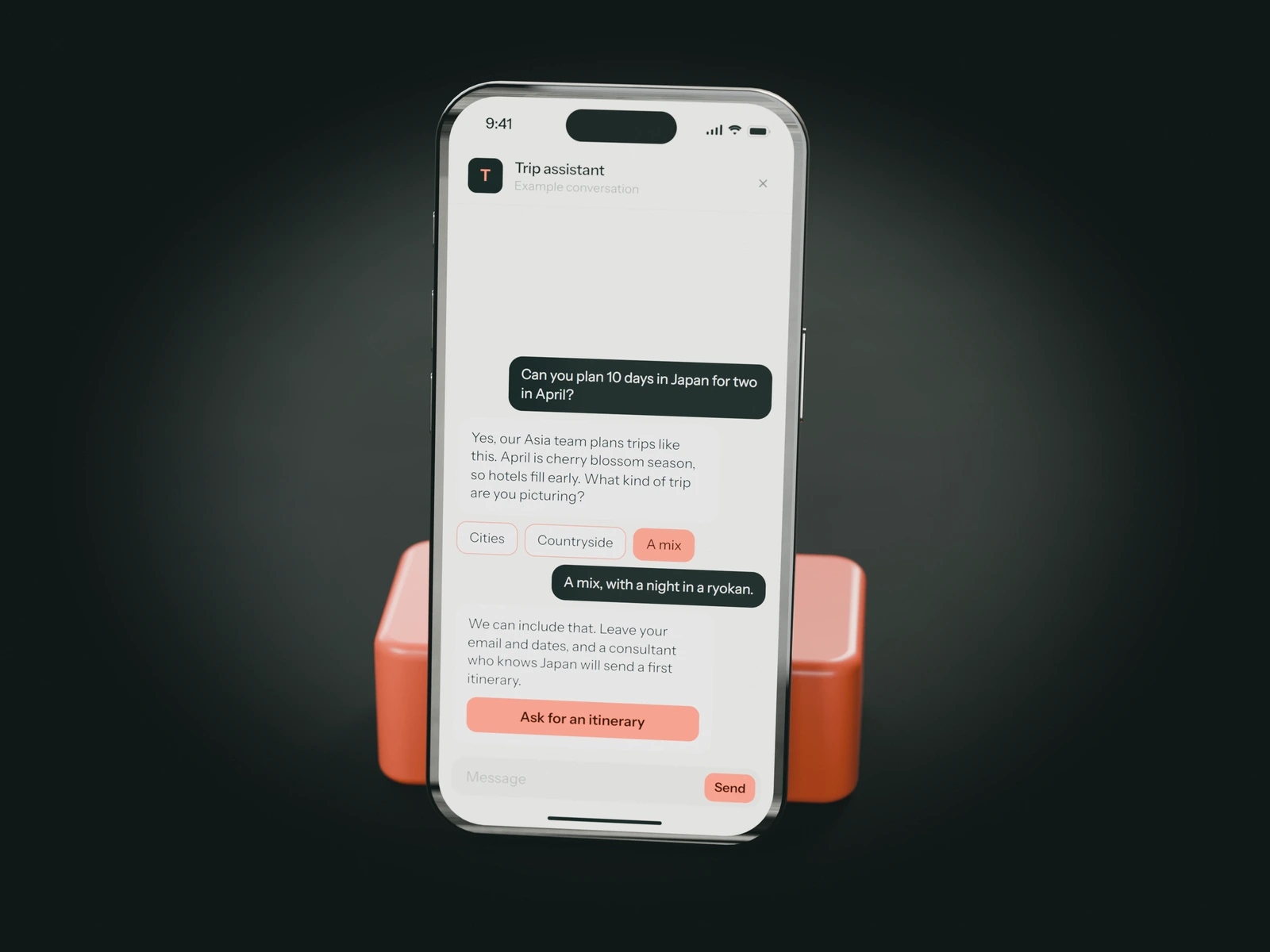
Can you plan ten days in Japan, what does the price include, can we pay in instalments, is there a family room, do I need a visa and who do I call if my flight is cancelled while I am away. Your consultants answer the same opening questions before any real planning starts. The chatbot answers from your trips and booking terms, and sends visa questions to official sources.
Grouped by where the trip stands: still an idea, being quoted, booked or under way.
What it may say is written down before we build.
Destination, dates and how flexible they are, who is travelling and their ages, the departure airport and the kind of trip. The consultant starts from a brief instead of a string of emails.
What each trip includes, room and board options, deposit and balance rules and your cancellation terms, as your own pages state them.
Travellers asking about documents or changes are asked for their booking reference, and the request goes to the consultant who made the booking.
Someone stuck after a cancelled flight sees your out-of-hours number first, and whoever is on call gets the conversation.
Someone with no destination in mind is asked about the month, the budget, who is travelling and what they enjoy, then shown trips and guides from your own site. It suggests nothing you do not sell or have not written about.
Weddings abroad, school trips and club tours: it asks for the group size, dates, who pays and the group leader's details, and the enquiry goes to whoever handles groups.
When someone pastes a cheaper price from another site, the chatbot passes the link and their dates to a consultant. It never comments on the other price or promises to match it.
A traveller writes on a Sunday afternoon, a few weeks before a Thailand trip booked with the agency. The office is closed until Monday, and the booking software tells the chatbot which consultant handles each booking.
What your team gets. On Monday, Priya opens one message: the Patel booking, an extra night in Bangkok to price, documents to check. The vaccination question got official links and nothing more.
It does not give visa or health advice. It links to the official government pages and asks travellers to check them. It does not recommend insurance cover or confirm a fare, and it never asks for passport or card numbers in the chat.
Each enquiry reaches the consultant who knows that destination.
Briefs go to your inbox or travel booking software, where its API allows. We check what your software allows first.
A reminder to travellers before the balance is due, and travel documents sent at the time you choose.
These fill the long gaps between a quote, a booking and the flight home.
After a consultant sends a quote, the traveller gets a reminder before the price runs out, and the consultant hears when a quote has gone quiet. Re-pricing stays with the consultant.
Before tickets are issued, the lead traveller gets a form to confirm every name exactly as it appears on each passport. Mismatches go to the consultant. The form never asks for passport numbers.
When government travel advice changes for a country where you have travellers booked, your team gets a list of the affected bookings. Your consultants decide what to tell clients. We check what each government source publishes and what your booking software can export first.
A daily list of upcoming departures where a hotel, transfer or excursion has no supplier confirmation yet, so it is chased before the traveller leaves, not at the airport.
After the return date, a short message asks how the trip went. Problems go to the consultant, and travellers who opted in get a link to leave a review.
Most of this exists as PDFs, supplier emails and what your consultants know. We collect it once, and your consultants check it before launch.
Deposits, balance dates, cancellation and amendment charges, and any financial protection you hold, such as ATOL in the UK, as the PDF or page travellers agree to.
The trips on your site and the itineraries consultants send most often, with what is included, as pages or documents.
Consultant names, their regions and working days, plus whoever handles groups, so each brief reaches the right person.
The number travellers call while away, who is on call, and what counts as urgent for your agency.
The government travel advice, entry requirement and travel health pages for the countries your clients live in. The chatbot links them and never summarises them.
Your booking or CRM software and access, so we can check whether briefs can go in directly or should reach an inbox in the same format.
Recent enquiries with names removed, including a few from travellers who were already away and needed help.
Travellers check the big booking sites before they contact an agency. Your site has to show what a consultant adds.
Day by day, what is included and what is not, and how the price is worked out, such as per person sharing. Vague trip pages produce the same emails again and again.
Dates and how flexible they are, who is travelling, the departure airport and a budget, the same questions the chatbot asks, so every enquiry arrives in one format.
Who knows which region and the trips they have made themselves. Travellers often pick an agency for the person they will deal with, and the profile is where they check.
Your terms and the financial protection your bookings carry, in plain words, linked from every trip page, the enquiry form and the chatbot's answers.
Links to official travel advice, entry requirements and health pages, plus your own packing and check-in list. The page points to the sources and gives no advice of its own.
The out-of-hours number and what counts as urgent, one tap from the home page and easy to read on a phone in an airport queue.
Trip enquiries hold names, travel dates, children's ages, departure airports and budgets. Some mention their health: a heart condition, a pregnancy, a wheelchair on the flight. The chatbot does not ask about any of it. If a traveller raises it, the brief notes only that there is something to discuss, and the consultant reads the traveller's own words.
Passport numbers, dates of birth and card numbers go through your own secure booking process, never the chat. Before launch we agree what is stored and for how long, and whether each consultant sees only their own travellers' chats or the whole agency's.
No, entry rules change and depend on the passport someone holds, so it links to official government pages and suggests the traveller checks them.
It can share the prices on your published trips, as your website shows them. A tailor-made quote stays with your consultants, because fares and room rates move every day.
It shows your out-of-hours number first and flags the conversation for whoever is on call. Rebooking flights stays with your consultants.
Names exactly as they appear on passports, yes. Passport and card numbers go through your own secure booking process instead.
Yes. Each brief goes to the consultant who covers that destination, or to a shared inbox when they are off, so nothing waits for one person's morning. An alert goes out if a connection fails, and you choose who is on call for travellers who are away.
It depends on whether you control your own website. Some host agencies and franchises give you a page you cannot add code to. If you have your own site, yes. We check this at the free consultation before anything else.
It can suggest trips from your own site and collect a full brief. A priced itinerary stays with your consultants, because every flight, connection and room has to be checked with the supplier first.
No. It answers from your information, not the news. When something big happens, you add a short notice, and the chatbot answers from it with your out-of-hours number shown first. Travellers are still pointed to the airline and official sources.
Yes, from your booking conditions and in your wording. It says what protection your bookings carry and links the page. What someone is owed in a particular case goes to a person.
No. It only knows what you give it, and supplier contracts and net rates are not part of that. If you want your team to search supplier terms, that is a separate document assistant for staff, not the public chatbot.
Those and your booking terms show us what the chatbot needs to know. The consultation is free, over Google Meet, a voice call or text.