


Stock questions
Price, mileage, specification, history and availability, read from your website or stock feed. When a car sells, the chatbot stops offering it.
A chatbot on your dealership's website that answers questions about the cars you have in stock. Finance terms and trade-in figures stay with your team.
Discuss your chatbot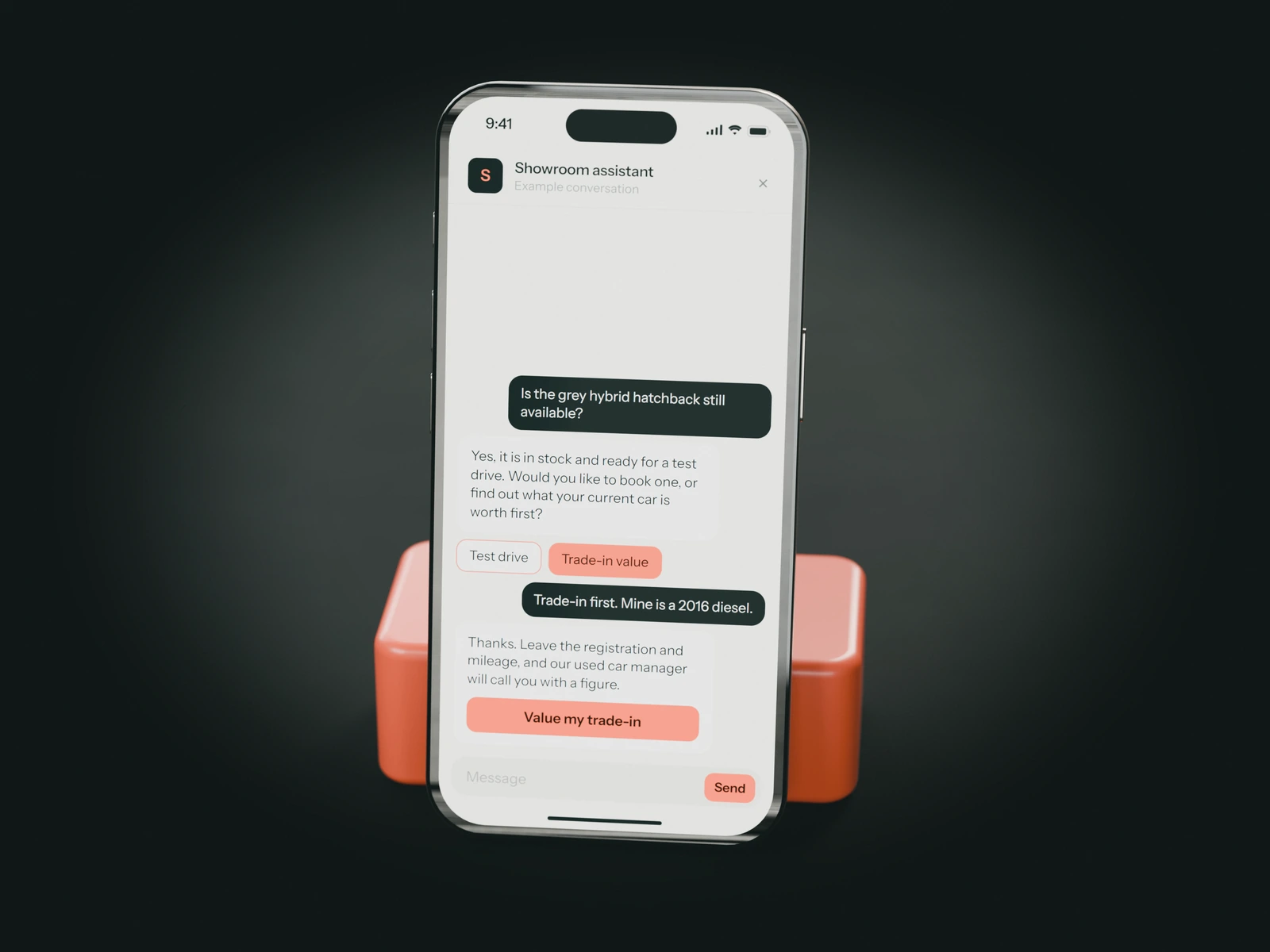
Is it still available, how many owners has it had, does it have a full service history, can I test drive it on Saturday, what will you give me for my car and can I spread the cost. Your stock listings answer the first three. The chatbot takes the test drive request and passes the last two to your used car manager and finance team.
Questions like these, taken from your own past web leads, are the test the chatbot has to pass before launch.
What it may say is written down before we build.
Price, mileage, specification, history and availability, read from your website or stock feed. When a car sells, the chatbot stops offering it.
It collects the car, the preferred day and a contact number, reminds the customer to bring a driving licence and sends the request to your sales team.
It takes the registration or VIN, mileage, condition and photos where your tools accept them, and passes them to your used car manager. The figure always comes from a person.
It explains which finance options you offer, in your approved wording, and hands the customer to your finance team. It never works out monthly payments.
"Can I put a deposit on it?" It explains whether the deposit is refundable and how long a car is held, then sends your payment link or passes the buyer to sales. It never tells a buyer a car is reserved until your system shows the deposit.
Buyers who live far away want to see the car before they travel. It books a video call or a recorded walkaround with the salesperson, and explains your delivery options if you offer delivery.
"What is the difference between the SE and the SE L?" It compares the two from the specification in your stock data or manufacturer information you approve, without opinions on which is better value.
A buyer who lives two hours away writes on Sunday evening about a seven-seat SUV on the dealership's website. The showroom opens again on Monday.
What your team gets. On Monday morning the salesperson for the Kodiaq has a video walkaround to confirm, and the finance team has a call-back with the part exchange and the outstanding finance noted. Nobody has been promised a payment or a figure.
It does not negotiate on price, quote finance terms, run credit checks or promise what a trade-in is worth. Credit applications and anything that needs a signature go to your team with the chat so far. Before launch, we try it with the questions your sales team hears every week.
Your sales team gets each lead with the car and the questions already noted.
Leads land in your dealer CRM or a shared inbox with the car they asked about, where its API allows.
A confirmation the day before a test drive and, with the buyer's permission, a message when a similar car arrives in stock.
Most of these exist so a buyer hears from you before another dealer, and they run from your CRM and stock feed where those allow it.
When a web lead has had no reply from sales by a time you set, the sales manager gets an alert with the car and the buyer's questions, so someone picks it up before the buyer moves on.
The day after a test drive, the buyer gets a short message from the salesperson they met, with a link to the car and a way to ask a question. Nothing goes out if they have already bought.
If the buyer agreed to hear from you, a message when a car they asked about is reduced. It uses the price in your stock feed, so the message matches the website.
Before collection, the buyer gets the list of what to bring, such as a driving licence and proof of insurance, and how you accept the balance, so a missing document does not hold up the handover.
For buyers who said yes to reminders, a message when the car's first service with you is due, with a link to book it with your service department instead of a garage down the road.
Most of it already exists for your listings and your finance compliance. We need copies.
The same feed you send to listing sites such as AutoTrader or Cars.com, or the export from your dealer management system. It works best when the feed marks cars as reserved or sold.
The sentences your finance provider or compliance process has signed off, word for word. Finance is regulated, so the chatbot uses that wording and nothing looser.
Whether deposits are refundable, how long a car is held and how buyers pay, written the way you would explain it on the phone.
Sales by brand or site, the used car manager, finance, service and parts, with their hours. Leads only reach the right person if we know who that is.
Your preparation checklist, the history check you run, the warranty you include and anything you always do before handover, such as a service.
If you use a dealer CRM such as VinSolutions or DealerSocket, we check its API before promising that leads arrive with the car attached. If it cannot connect, leads reach a shared inbox in the same format.
Questions buyers sent by email and through listing sites, so we test the chatbot on the ones your team found hardest to answer.
Buyers often choose a car before they visit, so the stock pages do most of the selling. When an ad points at one car, a landing page for ads does the same job.
Twenty or more photos of the actual car, marks included, with mileage, owners, keys, service history and the next MOT or inspection date. Buyers who saw the scuff online do not argue about it at the desk.
Filters for make, body type, fuel, gearbox and price that stay set when the buyer goes back from a car page. Setting them again after every car is a reason to leave.
Show the price with any admin, preparation or delivery fees included or listed beside it, so the first conversation is about the car rather than a fee nobody mentioned.
If you show finance examples, use your lender's own calculator or approved examples. We would not build our own, because it could show figures your lender would not offer.
Registration, mileage, condition, photos and whether finance is still owed, sent to the used car manager in one piece. The form and the chatbot use the same fields.
Each department's hours, and each site's address, on its own line. A buyer who rings about a car at 8am should not reach a service desk that cannot help.
Car buyers often share more than a chat needs. People write that they have missed payments or have just changed jobs. The chatbot never asks about income or credit history. If a buyer volunteers it, the lead summary can say only that they want to talk to the finance team, and the detail stays in the conversation record your team can read.
Finance applications go through your lender's or finance platform's own forms, never the chat. Driving licences for test drives are checked at the showroom rather than photographed into a chat window. Deposits are paid on your payment page, so card numbers never pass through the conversation.
Part exchange details include the registration, the lender and roughly what is owed. Before launch we agree what is stored, for how long and who can read it, and in Europe the GDPR applies. Where your CRM allows it, sales staff see the car and the questions while finance details stay with the finance team.
No. It says which finance options you offer and passes the customer to your finance team. Monthly payments, rates and credit checks stay with them.
Yes, when it reads your website or stock feed, so its answers change when your listings do.
No. It gathers the details, and your used car manager gives the figure.
Yes. Sales, service and parts questions are sorted at the start, and service requests go to your service department or its booking tool where the software allows.
Yes. Evening and Sunday enquiries get answers about the car straight away, and the lead is waiting for your sales team when you open.
Yes. It reads the site from the car's listing, or asks the buyer which branch is nearest when the question is general. Each site's sales team gets its own leads, and service enquiries go to that site's service desk.
It can explain how ordering works at your dealership and describe specifications from manufacturer information you approve. Delivery dates and order prices come from your sales team, because they change and depend on the deal.
The chatbot reads your stock feed, so it says the car has gone and offers similar cars in stock. Listing sites can take longer to remove an advert than your feed, so buyers sometimes arrive from an old one, and the chatbot answers them the same way.
No. The chatbot sits on your own website. The same enquiry follow-up can pick up leads that listing sites email to you, where they arrive in a format we can read, so every lead gets the same alerts and reminders.
Yes. Each lead carries the conversation, so the salesperson reads what the buyer asked and exactly what the chatbot answered before calling. If an answer was wrong, you correct the information behind it and it stays corrected.
The chatbot can send buyers to the eligibility checker your finance platform provides, where you have one. The check runs on that platform, outside the chat, and the result goes to your finance team. The chatbot never sees or repeats it.
Add the questions your sales team answers most, and where web leads go now. The consultation is free, over Google Meet, a voice call or text.